

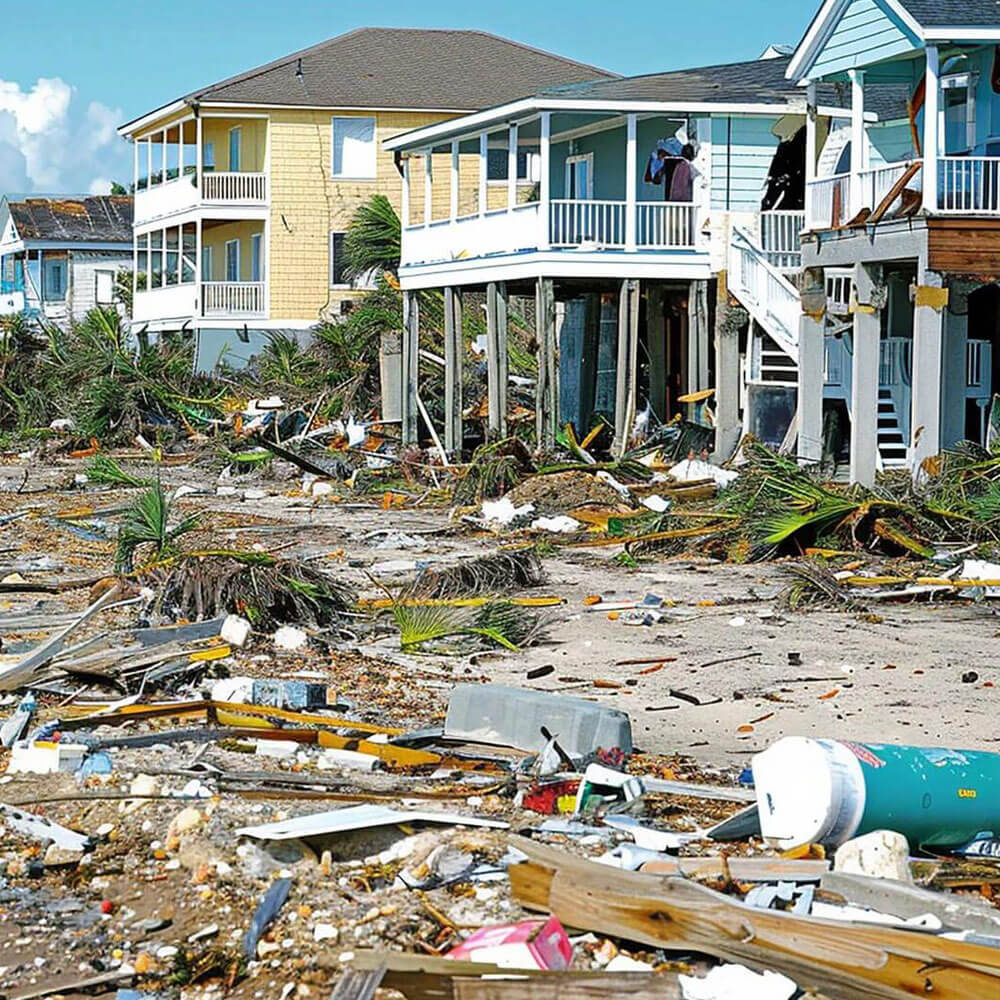
Hurricane insurance claims are most commonly denied through the wind versus flood argument, pre-existing damage claims, and misapplied policy exclusions, all of which a hurricane claims lawyer can challenge using independent engineering reports, meteorological data, and the insurer’s own claim file. The strength of your challenge depends on how well your damage is documented and how quickly you act before your suit limitation deadline runs.
When a hurricane damages your home or business in Texas, your insurance policy is supposed to be there. But for thousands of Houston-area policyholders, the claims process ends not with a check but with a denial letter. The reasons insurers give for denying hurricane claims are predictable, and so are the ways a hurricane claims lawyer challenges them.
The Houston hurricane claims lawyers at McLaurin Law represent policyholders whose claims have been denied, delayed, or underpaid. This post breaks down the most common denial reasons and explains exactly how each one can be contested, because a denial letter is not the final word on your claim.
How Insurance Adjusters Build a Denial
When your insurer sends an adjuster to inspect your property, that adjuster is not there to document everything you lost. Their job is to assess covered damage under the terms of your specific policy, and in doing so, they make decisions that shape the entire outcome of your claim.
Adjusters document what they find, characterize the cause of damage, apply depreciation, and produce a report that the insurer uses to accept, reduce, or deny your claim. After a major storm, adjusters are handling dozens of properties, which means inspections are often rushed, and damage is missed or misattributed.
And ultimately, the report, which drives everything that follows, is produced under time pressure by someone whose employer has a financial interest in keeping payouts low. A hurricane claims lawyer knows better than to accept that report at face value.
Common Reasons Hurricane Claims Are Denied in Texas
Wind versus flood (the most common denial)
Most standard homeowners’ policies cover wind damage but do not cover flooding. Hurricane claims often involve both: wind damages your roof or walls, and water enters through those openings. Insurers try to characterize all water damage as flooding to eliminate or reduce coverage, even when wind clearly breached your structure first.
The sequence of your damage matters. If wind created the opening and water entered through it, that water damage is wind-caused, not a flood exclusion. A hurricane claims lawyer works with structural engineers and meteorologists to document the timeline and sequence of your damage, establishing that wind entry preceded water intrusion.
Pre-existing damage and wear and tear
Adjusters routinely attribute hurricane damage to pre-existing conditions, aging materials, prior wear, and deferred maintenance, rather than the storm itself. This characterization allows the insurer to deny or dramatically reduce your claim by arguing your property was already in poor condition before the hurricane hit.
Pre-storm documentation is the foundation of this challenge. Photos, maintenance records, prior inspection reports, and contractor invoices that establish your property’s condition before the storm directly counter the adjuster’s narrative. An independent roofing or structural engineer can also assess whether your damage pattern is consistent with storm impact rather than gradual deterioration.
Adjusters who claim wear and tear caused damage that is physically consistent with high-wind impact are making an argument that can be dismantled with the right expert.
Scope undervaluation
Your claim may be accepted in principle but underpaid in practice. The adjuster’s report may limit covered damage to visible surface items, like a few damaged shingles or a broken window, while ignoring hidden structural damage, water intrusion into your wall cavities, mold development, and the full cost of bringing your property up to current building code after a major repair.
Independent contractor estimates from qualified professionals document the actual cost of your repair. Where the insurer’s scope is narrower than the true extent of your damage, your lawyer commissions expert reports that capture the full loss, including hidden damage, code-required upgrades, and contents.
Many Texas homeowners’ policies include replacement cost coverage, which means depreciation should not be deducted from your repair cost. If the insurer is applying depreciation to a replacement cost policy, that calculation can be challenged directly.
Policy exclusions (misapplied or overbroad)
Insurers sometimes deny your claim by pointing to policy exclusions that do not accurately apply to the type of damage you suffered. Common exclusions invoked after hurricanes include neglect, failure to maintain, cosmetic damage only, and earth movement. Some of these exclusions are applied too broadly or in ways your policy language does not actually support.
Your policy language controls. A hurricane claims lawyer reads the exclusion precisely and compares it to the facts of your loss. Exclusions that are ambiguous are interpreted in your favor as the policyholder.
Late notice
Insurers sometimes deny your claim by arguing you waited too long to report the damage. But Texas follows the notice-prejudice rule, which means your insurer must show that your delay caused them actual prejudice, meaning it materially harmed their ability to investigate, before they can deny your claim on late notice grounds alone.
Your lawyer examines whether the insurer can actually demonstrate prejudice. If weather records still exist, if your damage is visible, and if your property is accessible, the insurer’s ability to investigate has not been materially harmed. Your lawyer also documents why the delay occurred to establish that the delay was reasonable given your circumstances.
If your hurricane claim was denied for any of these reasons, a denial letter is not the end of the road. Contact McLaurin Law to review your denial and tell you whether the insurer’s reasoning holds up under Texas law.
What Texas Law Requires of Your Insurer During the Claims Process
Your insurer is not free to deny your claim without meeting specific legal obligations. Under the Texas Insurance Code, your insurer must acknowledge your claim within 15 days, accept or deny it within 15 business days of receiving all required documentation, and pay an approved claim within five business days.
It is an unfair settlement practice for your insurer to misrepresent your policy terms, fail to conduct a reasonable investigation, or refuse to settle your claim when their liability is reasonably clear.
If your insurer failed to meet these obligations in how they handled your claim, that failure may support a bad faith claim in addition to your coverage dispute.
The Tools a Hurricane Claims Lawyer Uses to Challenge Adjuster Reports
A hurricane claims lawyer does not simply write a letter to the insurer. The challenge to an adjuster’s report is built on evidence, and your lawyer coordinates the experts and documentation needed to make that challenge effective.
- Independent structural engineering reports: An engineer who inspects your property independently can assess the cause and extent of your damage using methodology the insurer’s adjuster cannot easily dismiss. This report directly challenges the adjuster’s characterization of your damage as pre-existing, wear-and-tear, or flood-caused rather than wind-caused.
- Meteorological data: Weather records from the time of the storm, like wind speed, direction, storm surge, and rainfall, establish what conditions your property actually experienced. This data is used to confirm that the storm was capable of causing your documented damage and to contradict any claim that the damage predates the storm.
- Contractor estimates and code analysis: Independent contractor estimates document the true scope and cost of your repair. Where the insurer’s estimate relies on outdated pricing, a narrow scope, or omits code-required upgrades, independent estimates provide the factual basis for a higher claim value.
- The claim file itself: Through discovery in litigation, a hurricane claims lawyer can obtain the insurer’s internal claim file, which includes adjuster notes, internal communications, and the reasoning behind your denial. That file often reveals exactly how the denial was constructed and where the insurer’s argument is weakest.
Your Houston Hurricane Claims Lawyer Has Seen This Denial Before
After Hurricane Beryl in 2024, Hurricane Harvey in 2017, and every major storm event in between, you and thousands of other Houston-area policyholders have faced the same pattern: rushed adjuster inspections, wind-versus-flood disputes, and pre-existing damage arguments used to minimize or deny claims that should be paid. The pattern is predictable because the tactics are taught.
A hurricane claims lawyer who understands how those tactics are constructed is in the strongest position to challenge them. McLaurin Law handles hurricane insurance claim disputes for Houston and Harris County policyholders. Contact McLaurin Law to discuss your denied or underpaid hurricane claim today.
Frequently Asked Questions About Denied Hurricane Insurance Claims in Houston
1. What is the most common reason hurricane insurance claims are denied in Texas?
The wind-versus-flood argument is the most common denial tactic after a hurricane in Texas. Standard homeowners policies cover wind damage but not flooding, and insurers frequently characterize your water damage as flood-caused even when wind breached your structure first. A hurricane claims lawyer challenges this by establishing the sequence of your damage, showing that wind entry preceded water intrusion, using engineering reports, weather data, and photographs.
2. Can I challenge an insurance adjuster’s report after a hurricane claim denial?
Yes. An adjuster’s report is not final. You have the right to obtain an independent inspection, commission your own engineering and contractor reports, and retain a hurricane claims lawyer to challenge the adjuster’s findings. The insurer’s characterization of your damage is a starting position, not a legal conclusion.
3. What does a hurricane claims lawyer actually do to fight a denial?
A hurricane claims lawyer reviews your policy, your denial letter, and the adjuster’s report to identify where the insurer’s reasoning is legally or factually vulnerable. They coordinate independent experts (engineers, meteorologists, contractors) to produce evidence that directly counters the adjuster’s findings. They handle all communication with the insurer, send the required pre-suit notice under Chapter 542A when appropriate, and pursue litigation if the insurer will not settle your claim fairly.
4. What if the adjuster said my damage was pre-existing?
Pre-existing damage is one of the most common and most challenging denial arguments. Pre-storm photographs, maintenance records, and an independent engineering assessment showing that your damage pattern is consistent with storm impact rather than gradual deterioration can directly refute this characterization. The burden is on the insurer to prove the damage predates the storm, not on you to disprove it.
5. How long do I have to challenge a hurricane insurance claim denial in Texas?
Your deadline depends on your specific policy. Most Texas homeowners’ policies include a suit limitation clause that runs from the date of your loss, not the date of your denial. You also need to send a pre-suit notice at least 61 days before filing a lawsuit under Chapter 542A of the Texas Insurance Code. Multiple deadlines may be running at the same time.
6. What is the difference between a public adjuster and a hurricane claims lawyer?
A public adjuster is a licensed professional who assesses your damage and negotiates your claim value with the insurer on your behalf. They can be a valuable first step, but they cannot file a lawsuit, send a legally required pre-suit notice, or represent you in litigation. A hurricane claims lawyer handles the full picture, from reviewing your policy and challenging the adjuster’s report to filing suit and taking your case to trial if the insurer will not settle fairly.
